FRANCE · 2011 · THEATRICAL · FINE ART
Hôtel Particulier
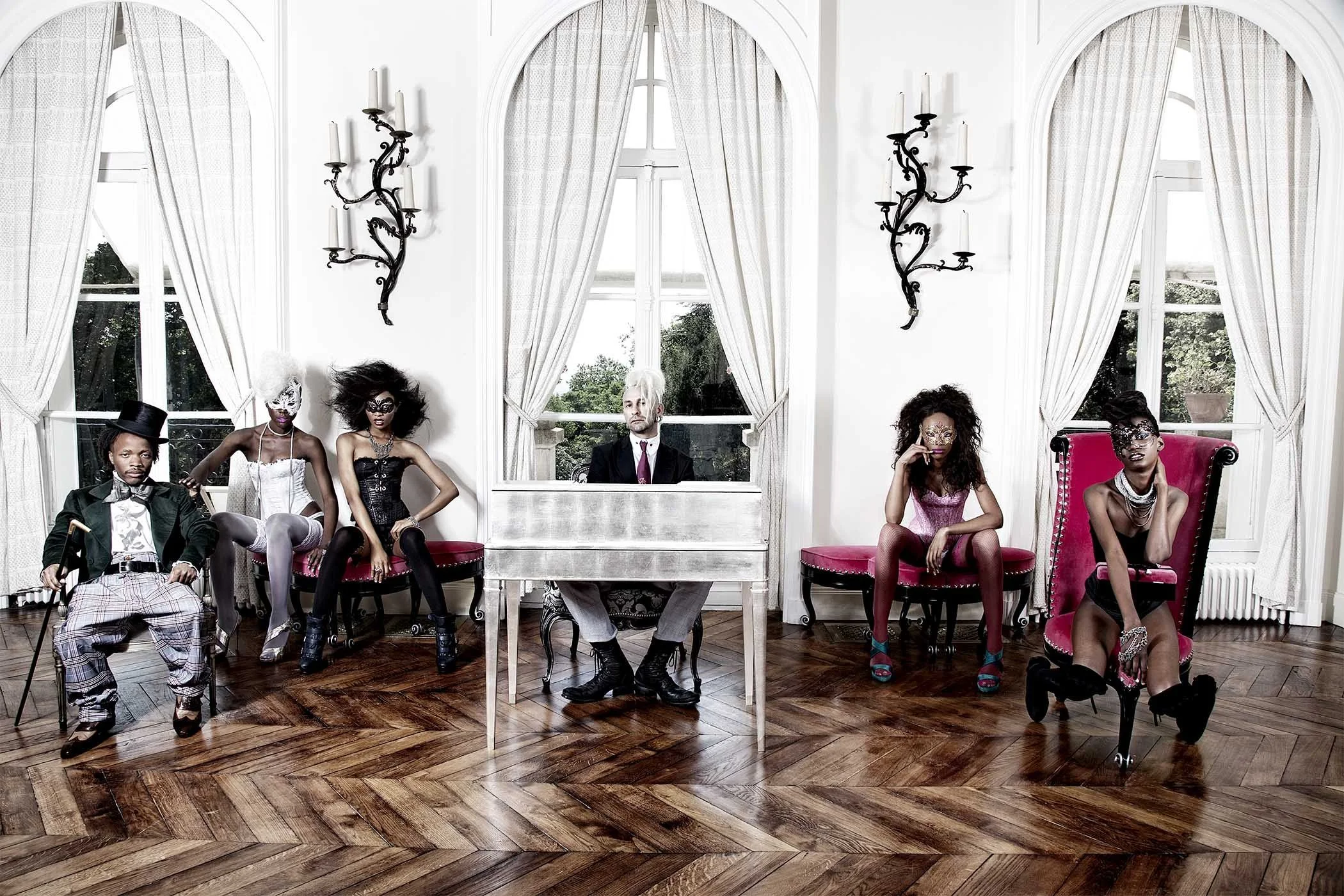
An 11th-century priory outside Paris. Thirty designers given carte blanche. Forty models — some professional, some cast between two metro trains. Six days. Fifteen crew. One rule: every room tells a story nobody wrote.
The commercial network built the guest list. The art built the hotel.
Self-funded. Self-directed. Exhibited at GRK Gallery Paris and Art Monaco.

THE GENESIS
New Year's Eve. A Château. An Idea.
Back in France after Bangkok. Leon Le Baron launched. Maison & Objet twice a year. Salon de la Lingerie. Who's Next. Trade shows where I met designers who had no idea they were about to become cast members.
December 31st, 2010. A party at a friend's apartment. I meet Zoé Elvinger. She mentions she lives in a château — an 11th-century Benedictine priory overlooking the Seine, in Evecquemont, 40 kilometers west of Paris. 1,285 square meters. Reconstructed in 1908 as a neoclassical folly, then acquired in 1937 by her grandfather Francis Elvinger — a pioneer of advertising theory, professor at the University of Louvain, author of eight editions of La Marque. The same rooms that hosted L'Heure Zéro, Le Grand Pardon, and Neuilly sa mère.
I had the designers. I had the contacts. Now I had the location. By January, production was underway.
SHE SAID CHÂTEAU. I HEARD FILM SET.

THE PRODUCTION
A Sprained Ankle and a Blackboard Wall
March 2011. A severe ankle sprain. Five flights of stairs. No elevator. I couldn't leave my apartment for weeks. My bedroom became the war room — bed on the left, desk facing the wall, window on the right. A blackboard wallpaper covered one wall. Chalk notes. Post-its. Magazine pages cut and pinned. Every moodboard, every designer brief, every model card — planned from that room in the 19th arrondissement, overlooking the Canal de l'Ourcq.
The injury forced the focus. I stopped going out. I started producing. Excel files. PowerPoint decks sent to thirty designers. Costume rentals from Le Vestiaire in La Courneuve. Press offices contacted for accessories. Insurance negotiated for furniture worth tens of thousands. The production that seemed impossible became inevitable — because I couldn't walk away from it. Literally.
THE ANKLE BROKE. THE PROJECT DIDN'T.


THE SHOOT
Six Days. Forty Models. Salade Pizza Vodka.
June 2011. Two weekends. Friday, Saturday, Sunday. Forty models arriving by train from Paris. Fifteen crew — hair, makeup, styling, assistants. €50,000 worth of lighting equipment loaned by Photorent, where I'd been renting gear since my return to France. Self-funded from a sale of prints to the Sofitel Saigon through Pierre Maciag — around €14,000 that became the entire production budget.
Each room was stripped of its original furniture and redressed with pieces from the designers — Taillardat's heritage furniture, Volevatch's fixtures, Cadolle's lingerie. I directed everything. Styled everything. Briefed the hair and makeup team with moodboards I'd built from my blackboard wall. Then gave them creative freedom within the frame.
Six to seven setups per day. Grand salon. Winter garden. Alcove salon. The château's balcony. Shot at 14mm — wide enough to swallow the room, close enough to catch the expression. Silver umbrella flash. The church bells of the priory next door rang at exactly 7pm, the moment I pressed the shutter on "Do You Truly Believe in God?" You can't stage that.
Street-cast models next to professionals. Heritage luxury next to underground fashion. The last evening ended with margaritas and the same song on repeat because nobody wanted it to stop.
IT WASN'T A SHOOT. IT WAS A PARTY THAT PRODUCED ART.
THE CONCEPT
A Hotel Outside of Time
An imaginary hotel with imaginary guests and imaginary staff. The Bodyguard. The Receptionist. The Unconventional Groom. The Confident. The Concierge. Insomnia. Each character dressed by a different designer. Every frame a scene from a film that was never made — sustained, sometimes extravagant, rooted in the DNA of subversive luxury and baroque theatricality.
References stacked like layers — V for Vendetta, Ready Player One, Le Déjeuner sur l'herbe. "Do You Truly Believe in God?" is a direct nod to the bishop scene in V for Vendetta. The Unconventional Groom was born when I saw a Volevatch shower that looked like a five-star hotel luggage cart — so I put a bellboy inside it. Every artwork has an origin story. Most of them started as a bad joke.
The presentation deck I sent to partners included brands I hadn't confirmed yet. Some saw the deck and said yes because they thought everyone else already had. The bluff built the project. The project justified the bluff.
During World War II, the Germans requisitioned the château — Rommel's headquarters were stationed just kilometers away at La Roche-Guyon. I found the original occupation contract in the archives. Francis Elvinger's office. First floor. Grand library. I cleared half the room, brought in Taillardat furniture, sourced old books from everywhere I could. Then I staged the scene: a baron signing the contract. A German officer watching. A man with a briefcase in a Hedus Philosophy suit. The baron's wife standing behind. On the desk — a typewriter with the contract ready to sign. I even placed a dead fly I'd found on the paper. Every detail scrutinized. The history of the room became the fiction of the photograph.
EVERY ROOM HAS A SECRET. I JUST MAKE IT VISIBLE.
The dead fly was real. Everything else was staged. That's the point.


THE COLLABORATORS
Thirty Creators. One Château.
Lingerie — Cadolle (Poupie Cadolle, granddaughter of Herminie Cadolle, inventor of the modern brassiere), Nicole de Carle, Britta Uschkamp, Bordelle. Fashion — Anne-Cécile Meignan, Voriagh, Hedus Philosophy. Accessories — Inès de Castilho, Luna Veneziana, Pierre Mantoux. Furniture — Taillardat, Volevatch, At-Once, Slide, De Castelli. Interior Design — Chantal Thomass, Nina Campbell, Tristan Auer.
Brands classified EPV (Entreprise du Patrimoine Vivant) alongside emerging designers. Rue du Faubourg Saint-Honoré alongside street casting from the Parisian metro. The hotel had no dress code — except ambition.
THE GARMENT BECAME THE SET. THE MODEL BECAME THE CHARACTER. THE CHÂTEAU BECAME THE STORY.
Entirely self-funded. For the love of creation.

The Syndrôme of Love
WHAT HAPPENED NEXT
The Hotel Checked Out. The Art Stayed.
Hôtel Particulier was shot in June 2011. By September, the images were placed with a distribution partner. By January 2012, they exhibited at Maison & Objet. Then at GRK Gallery Paris. Then Art Monaco.
The château returned to silence. The designers moved to new collections. But the images became fine art works that outlived every brief, every trade show, and every business card exchanged at Maison & Objet.
This series was the transition. The same skills built in Bangkok — art direction, creative concepts, production management, street casting — now served a personal vision instead of a client's brief. The machine built for commissions ran its first job for itself.
THE COMMISSIONS BUILT THE MACHINE. HÔTEL PARTICULIER WAS THE FIRST TIME I USED IT FOR MYSELF.
Available as fine art limited editions. For exhibition enquiries or acquisitions.
New collections. Drop announcements. Studio updates.